
How to Pray When You Don't Know What to Say (A Simple Way to Start)
She sits on the edge of the bed with her hands folded and her Bible on the nightstand, unopened. She says, "Dear Lord," and then nothing comes. Forty seconds of silence. The clock ticks. She wonders if that counts.
If you have ever been there, you are in good company. Most believers hit this wall at some point, usually on the days they need prayer the most. The words that came easily last month are gone, and what is left feels too messy, too tired, or too big to say out loud.
This post is a gentle way back in.
You are not the first to ask
Look at how the Bible treats this problem. It does not pretend it away. In fact, Paul says it plainly:
"Likewise the Spirit also helpeth our infirmities: for we know not what we should pray for as we ought: but the Spirit itself maketh intercession for us with groanings which cannot be uttered." (Romans 8:26)
Paul, who wrote much of the New Testament, says we know not what we should pray for. He includes himself. And the disciples did too. One of them finally asked Jesus, "Lord, teach us to pray" (Luke 11:1), which tells you that even the people who walked with Him every day did not think prayer came automatically.
So the first thing to let go of is the idea that you are failing at something everyone else finds easy.
Long is not the same as good
Many of us picture good prayer as long, polished and full of the right words. Jesus pushes back on that:
"But when ye pray, use not vain repetitions, as the heathen do: for they think that they shall be heard for their much speaking." (Matthew 6:7)
And then comes the line that takes the pressure off: "for your Father knoweth what things ye have need of, before ye ask him" (Matthew 6:8). He already knows. You are not informing Him. You are showing up.
That means a prayer of three honest sentences is a real prayer.
A simple pattern: P.R.A.Y.S.
When you cannot think what to say, a small structure helps. This one has five steps, and the letters spell the word. It is not a rule from Scripture, just a pattern that gives your mind somewhere to stand.
P is for Praise. Start with who God is, not with your list. Even one line will do. The psalmist wrote, "Enter into his gates with thanksgiving, and into his courts with praise" (Psalm 100:4), and you can start in that doorway.
R is for Repent. Tell Him what you have been carrying or holding back. Not a performance, just the truth. A prayer many people borrow here is, "Create in me a clean heart, O God; and renew a right spirit within me" (Psalm 51:10).
A is for Ask. Bring the need plainly. Paul tells us to let our "requests be made known unto God" (Philippians 4:6). You do not have to dress it up.
Y is for Yield. Open your hands and trust Him with the outcome. Jesus prayed this in the garden: "nevertheless not my will, but thine, be done" (Luke 22:42). It is the hardest step and often the one that brings the most peace.
S is for Still. Stop talking. "Be still, and know that I am God" (Psalm 46:10). Sit for one minute with no agenda. Most of us skip this step. It may be the one we need most.
Let a verse do the talking
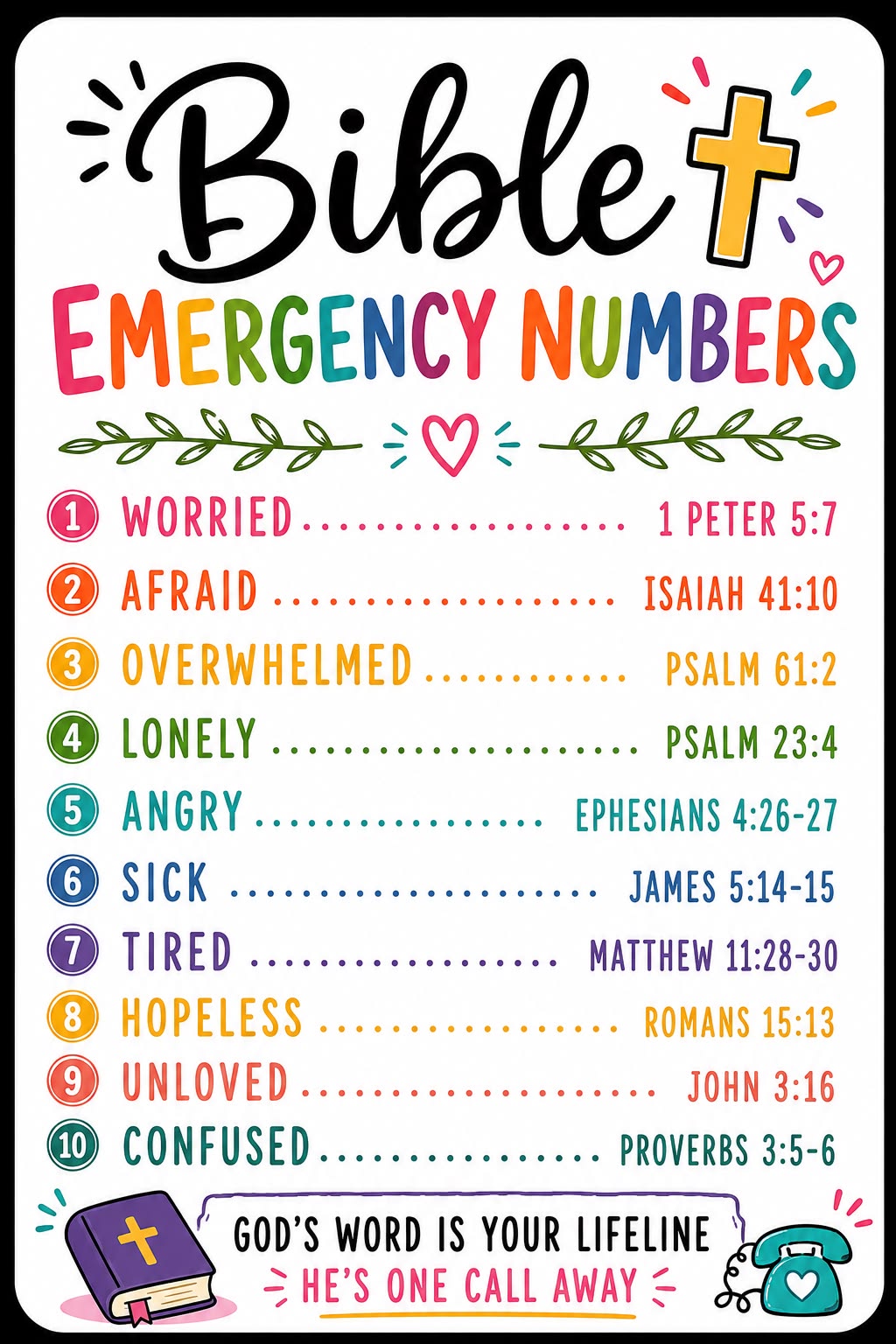
Here is where Bible emergency numbers come in. When you cannot find words, borrow them. Pick the feeling that matches yours, read the verse out loud, and then pray it back to God.
Say the feeling is worried. The verse is:
"Casting all your care upon him; for he careth for you." (1 Peter 5:7)
Then the whole prayer might sound like this:
Praise: Lord, You are the God who cares. Repent: I have been holding onto this worry like it is mine to fix. Ask: Please help me with the thing I am dreading this week. Yield: I give it to You, and I trust You with how it turns out. Still: (one quiet minute)
That is under a minute of speaking, and every line is honest. Nothing in it is fancy.
Why this works when you are worn out
A verse is short, so you can find it fast. It is true, so you are not inventing anything. And it is written down, so you do not have to hold it in your head. A tired mind can follow a five-step pattern much more easily than a blank page.
Keeping it where you can reach it
These ten numbers (worried, afraid, overwhelmed, lonely, angry, sick, tired, hopeless, unloved, confused) are the free Bible Emergency Numbers pack from Path of the Heart: a rainbow poster, wallet cards and bookmarks. The P.R.A.Y.S. prayer pages, one for each of the four volumes, are inside the Mega Bundle: 40 numbers with full King James text, 40 wallet cards, a call log and note cards, 35 pages in all, for $4.99. Each page lists the feelings for that volume and gives you a line to write in for every step.
If you are not sure, start with the free one. It prints as many times as you like.
How people actually use them
On the nightstand, so there is something to pick up when the words will not come. In the car, with a wallet card, before walking into a hard appointment. At the kitchen table with coffee, one verse and one minute. In a small group, with each person choosing a number. And in the call log, writing down what you noticed during the quiet minute, because that is often where the answer starts.
Back to the edge of the bed
She does not need to say it perfectly. She opens the Bible, finds one verse, and reads it out loud. Then she says it back. He careth for you. Then she sits still, and the minute that felt empty a moment ago is no longer silent.
 Reviewed by Path of the Heart
on
October 26, 2026
Rating:



No comments: