
The text comes in at 9:48 at night. Leaving now. Love you. Her daughter is driving three hours alone, in the dark, in a car that is older than she is.
She types back a heart and a thumbs up, which is the opposite of what she’s feeling. Then she stands in the hallway with the phone in her hand and does the only thing she knows to do. She starts saying a verse.
Psalm 91:11 is the one she reaches for. It’s also one of the most misunderstood verses in the Bible, and that’s worth getting right.
What the words actually say
The King James reads: “For he shall give his angels charge over thee, to keep thee in all thy ways.”
Three words carry most of it.
Charge. The Hebrew is tsavah, and it means to command, to appoint to a duty by authority. This isn’t a casual presence. It’s an assignment.
Keep. The Hebrew is shamar, which means to guard, to watch over, and in its root, to hedge about, the way you’d put a thorn hedge around something precious.
Ways. The Hebrew is derek, a road, a path, a course of life. Not just the dangerous moments. The whole route.
Read the verses on either side
The verse begins with “for,” so it’s giving a reason. Verse 9 says: “Because thou hast made the LORD, which is my refuge, even the most High, thy habitation.” Verse 10 adds: “There shall no evil befall thee, neither shall any plague come nigh thy dwelling.” Verse 11 follows as the reason. The one who lives in God as home is the one watched over.
Angels aren’t random in this picture. They’re messengers, which is what the Hebrew word means, sent by God for a purpose.
The wilderness twist
Here’s the part that gets skipped. In Matthew 4:6, Satan quotes this very verse to Jesus in the wilderness and dares Him to throw Himself off the temple. The tempter left out the words “in all thy ways.” That omission matters. The promise attaches to the path God sends you on, not to a dare. Jesus answered from Deuteronomy, refusing to put God to the test.
So Psalm 91:11 isn’t permission to take reckless risks, and it isn’t a guarantee that nothing hard will ever happen. It’s a promise about being watched over while you walk where you’re supposed to be.
What Scripture does and doesn’t tell us
Psalm 34:7 says: “The angel of the LORD encampeth round about them that fear him, and delivereth them.” Hebrews 1:14 describes angels as ministering spirits sent to serve those who will inherit salvation.
That’s all Scripture says about how this works. We don’t get a map of who guards whom, or how. What we get is the assurance that God hasn’t left the watching to chance.
A way to hold this on a long night
You can say the verse over someone you can’t reach. Some women keep it on the car visor, or read it aloud when a child, a husband, or a friend pulls out of the driveway. It doesn’t control the road. It places the road in the right hands.
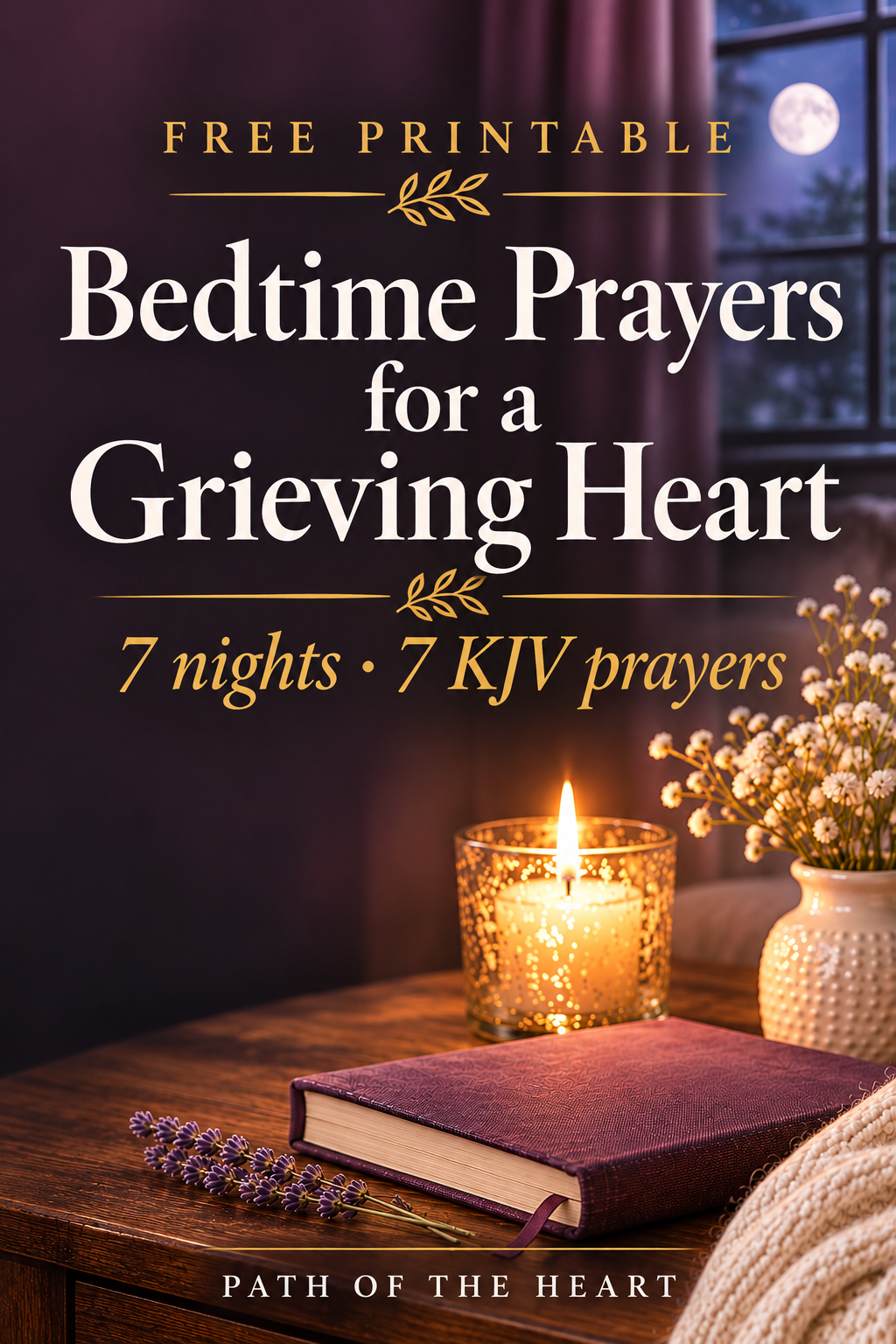
A free card to keep it close
We made a free Psalm 91:11 scripture card in the King James text, ready to print:
Get the free Psalm 91:11 scripture card →
Tuck one in your Bible, one in the glove box, and give one to someone who is about to travel. If you want more of the psalm, the Psalm 91 KJV Kit goes further.
Back to the hallway
Her phone lights up again at 11:52. Made it. Parked. She lets out a breath she didn’t know she’d been holding.
The road wasn’t different from what she feared. But somewhere between 9:48 and 11:52, she said the verse, and she wasn’t alone in the hallway.
For he shall give his angels charge over thee, to keep thee in all thy ways.
 Reviewed by Path of the Heart
on
November 02, 2026
Rating:





No comments: