
It is 2:14 in the morning. The refrigerator hums. A car passes outside, its headlights sliding across the ceiling and gone. You have checked the clock four times, and every time you hoped it was later than it was.
Nothing new has happened tonight. But the grief that stayed polite all day, through the phone calls and the paperwork and the kind people at the door, has quietly sat up in bed beside you.
Why the dark makes it louder
Daytime hands you things to do. A thank-you note. A line at the pharmacy. A coworker who needs an answer by noon. These tasks are small, but they take up room, and grief has to wait its turn behind them.
At night the room empties. Nobody needs anything from you. The mind, with nowhere else to go, goes back over everything: the last conversation, the thing you meant to say, the way the hallway sounded when they were still in it. A tired body makes it harder, because a tired mind has less strength to turn away from the same thought for the ninth time.
So if grief is louder after dark, it does not mean your faith is failing. It is simply the hour when there is finally space for it.
The Bible never looks away from the night

Scripture is honest about this. David wrote, “I am weary with my groaning; all the night make I my bed to swim; I water my couch with my tears” (Psalm 6:6). He did not tidy it up for company. Job said, “My bones are pierced in me in the night season: and my sinews take no rest” (Job 30:17). And another psalmist cries, “O my God, I cry in the day time, but thou hearest not; and in the night season, and am not silent” (Psalm 22:2).
Notice what these men do not do. They do not apologize for the tears, and God does not scold them for crying. The night season is written right into the Bible, which means it was never outside His reach.
He also has a word for it. “Weeping may endure for a night, but joy cometh in the morning” (Psalm 30:5). It says a night. It does not pretend the night is short, or that you can skip it. It says the night ends, and that you are not alone while it lasts. “The LORD is nigh unto them that are of a broken heart” (Psalm 34:18). Nigh means near. Near at 2 a.m., too.
What actually helps when you cannot sleep
Nothing dramatic. A prayer short enough to say with your eyes closed. A notebook on the nightstand, so the thought that keeps looping can be written down and set aside until morning. A dim lamp instead of a bright phone.
And a gentler goal. You do not have to make yourself sleep. “For so he giveth his beloved sleep” (Psalm 127:2). The verse says giveth. Sleep is a gift He hands over, not a grade you earn. Rest your body even when your mind will not rest, and let that be enough for tonight.
If weeks go by and you are hardly sleeping at all, tell your doctor or a counselor. That is not a lack of faith. It is care for the person God made.
A short prayer for 2 a.m.
Father, it is the middle of the night and I am awake again. You see me. I don’t have the right words, so I’m giving You the ones I have. I miss them. I am tired. I am afraid of the quiet, and I am afraid of the morning. Hold what I can’t hold tonight. Let this room be a place where You are near. Give me rest, even a little, and when the morning comes, give me strength for one more day. Amen.
Seven nights of prayers, free
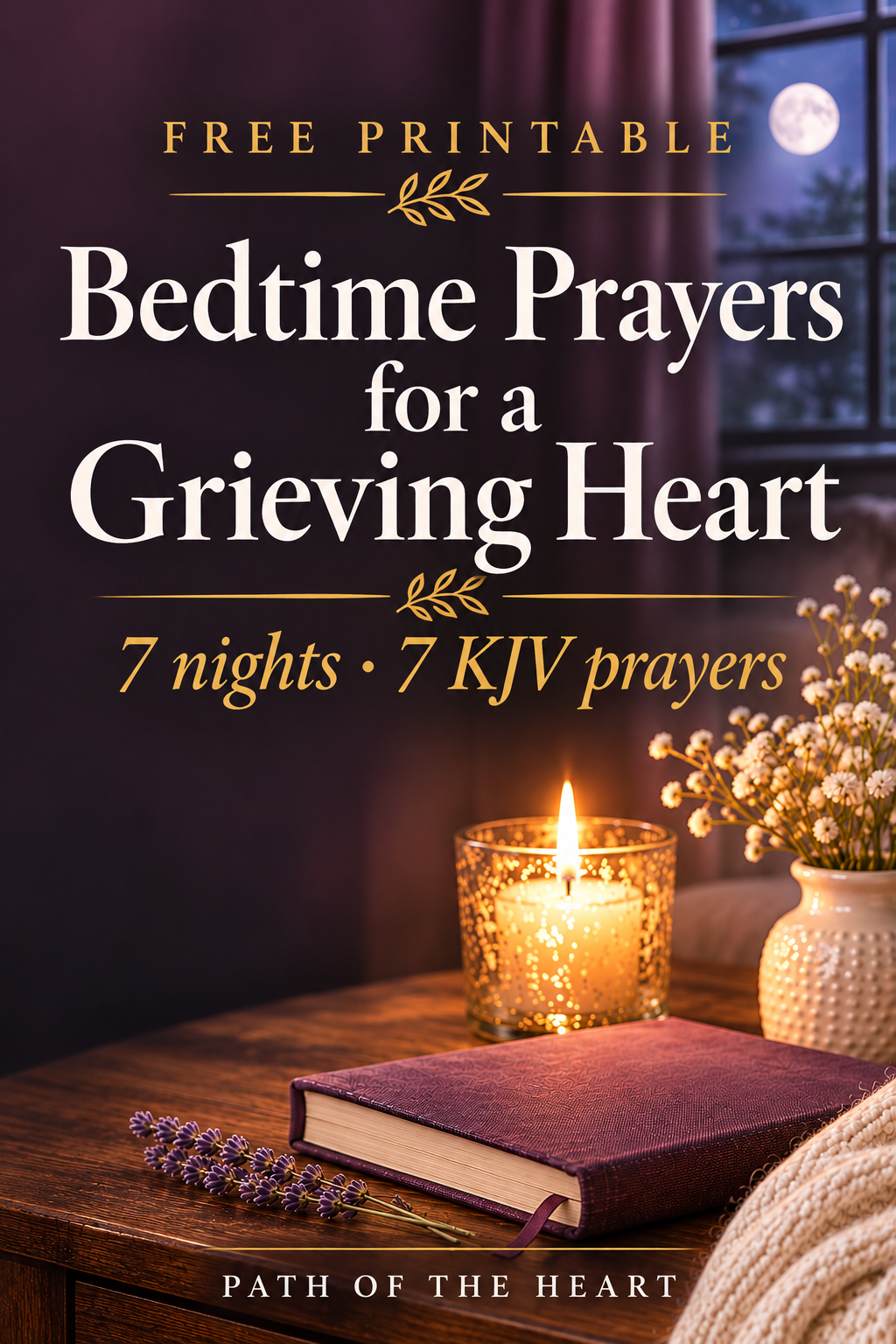
If you want words ready before the next sleepless night, Path of the Heart made a free PDF called Bedtime Prayers for a Grieving Heart. It holds seven short prayers, one for each night of the first week after a loss, and each rests on a King James verse. The nights are named for what they carry: when the grief feels too heavy, when you feel alone, when you cannot sleep, when you are angry and full of questions, when you are afraid you will forget, when you need to give thanks again, and when you need hope for the morning. It is free, and it asks nothing of you.
Read one slowly before you close your eyes. Pray the same one all week if it helps. Keep it on your phone for the nights you cannot reach for a book, or print it and slip it inside your Bible. And if a friend is grieving, you can send it to her as a quiet way of saying you are thinking of her.
For the longer road, there is a companion: Through the Valley, a Christian grief prayer journal with 30 daily prayer pages, a gentle habit tracker, and a 30-day challenge.
Back to 2:14
The hallway will probably still sound different tomorrow. The clock may say 2:14 again. But “he that keepeth Israel shall neither slumber nor sleep” (Psalm 121:4), and that means someone is awake in that room with you, keeping watch so you can lay yours down.
 Reviewed by Path of the Heart
on
November 08, 2026
Rating:






No comments: